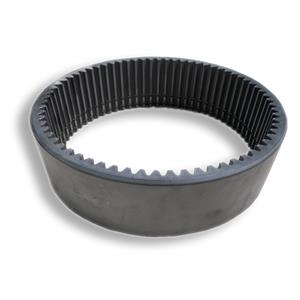
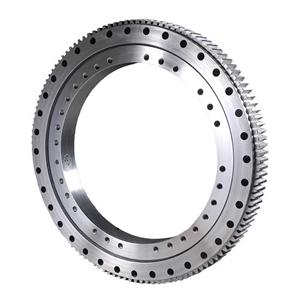
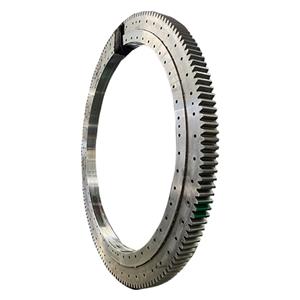
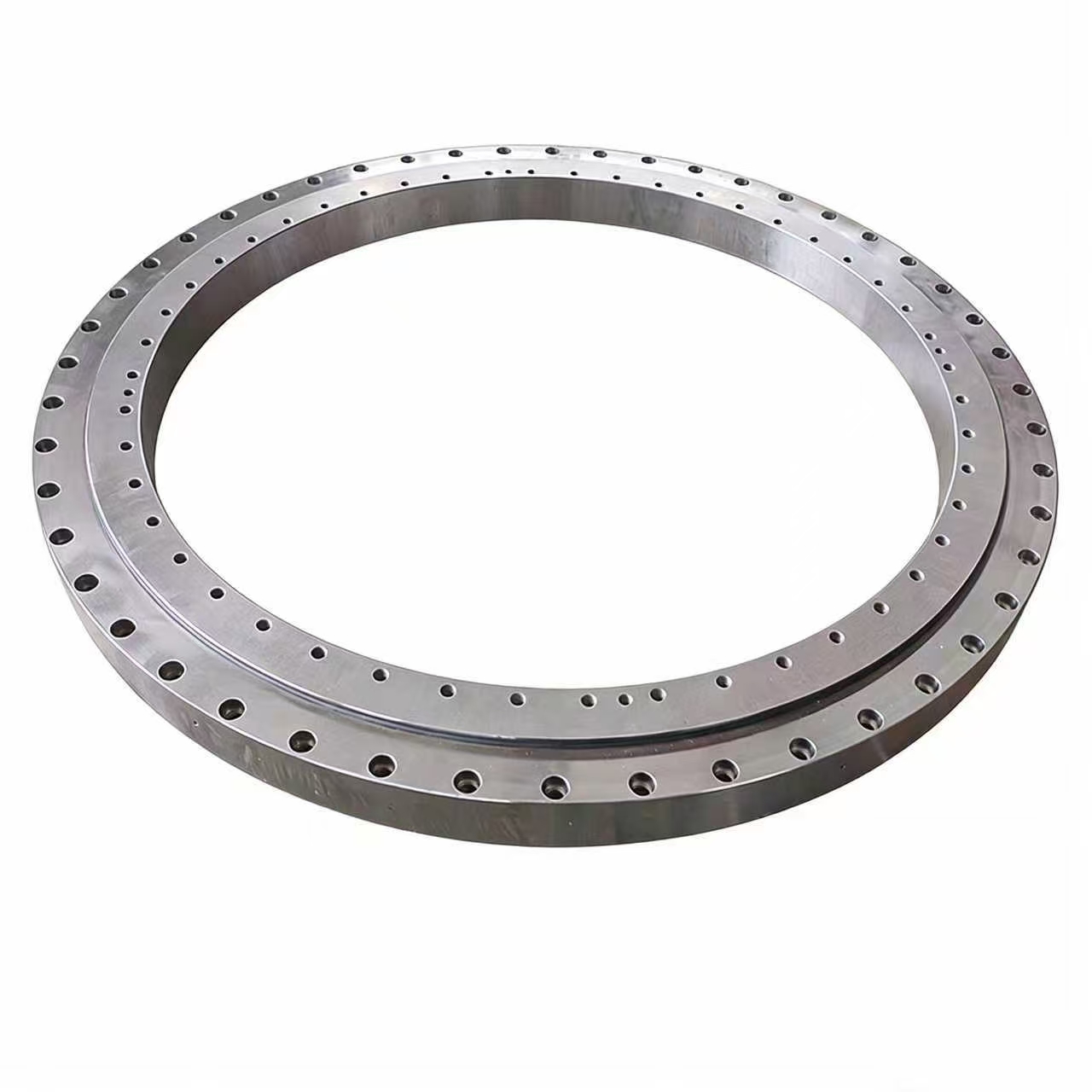
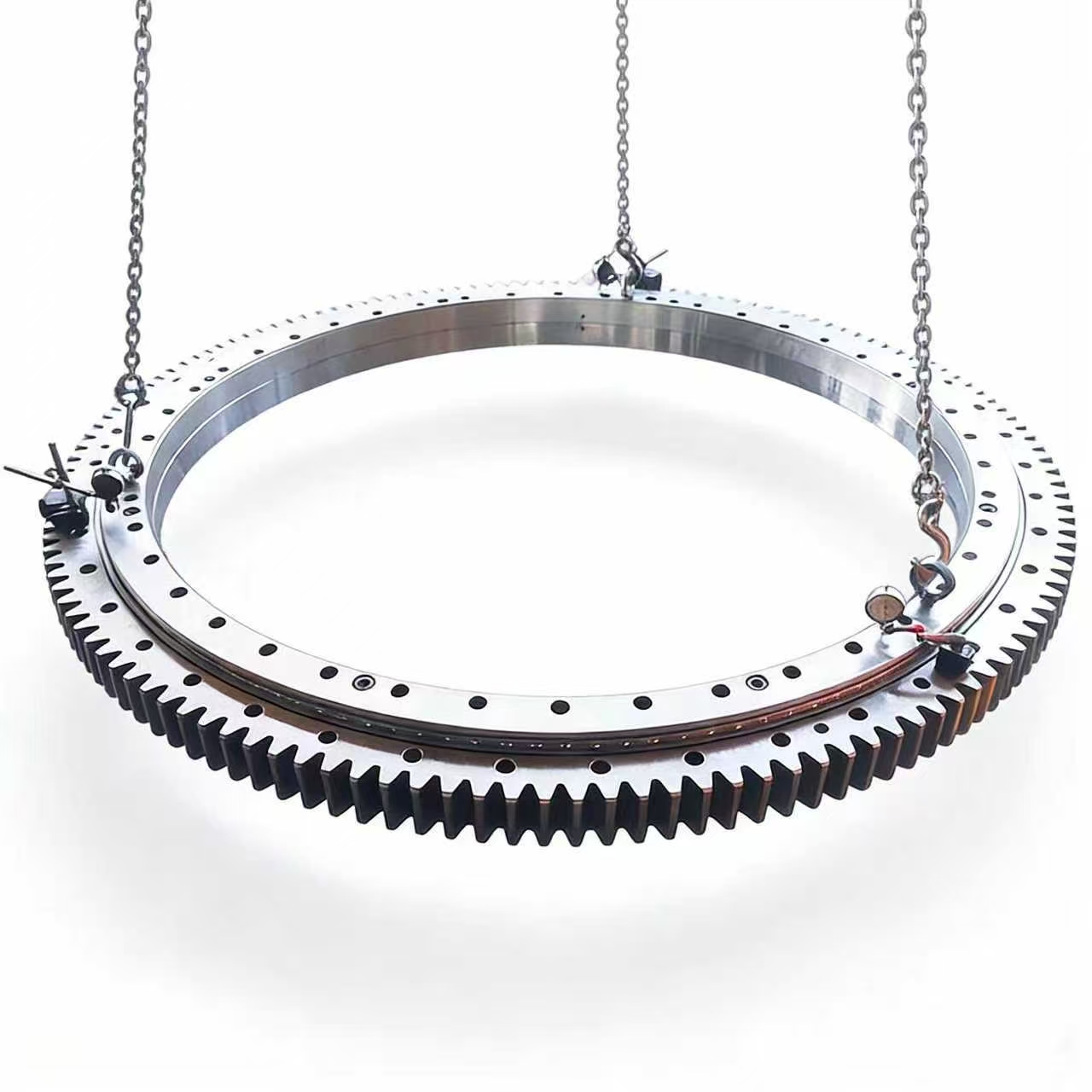
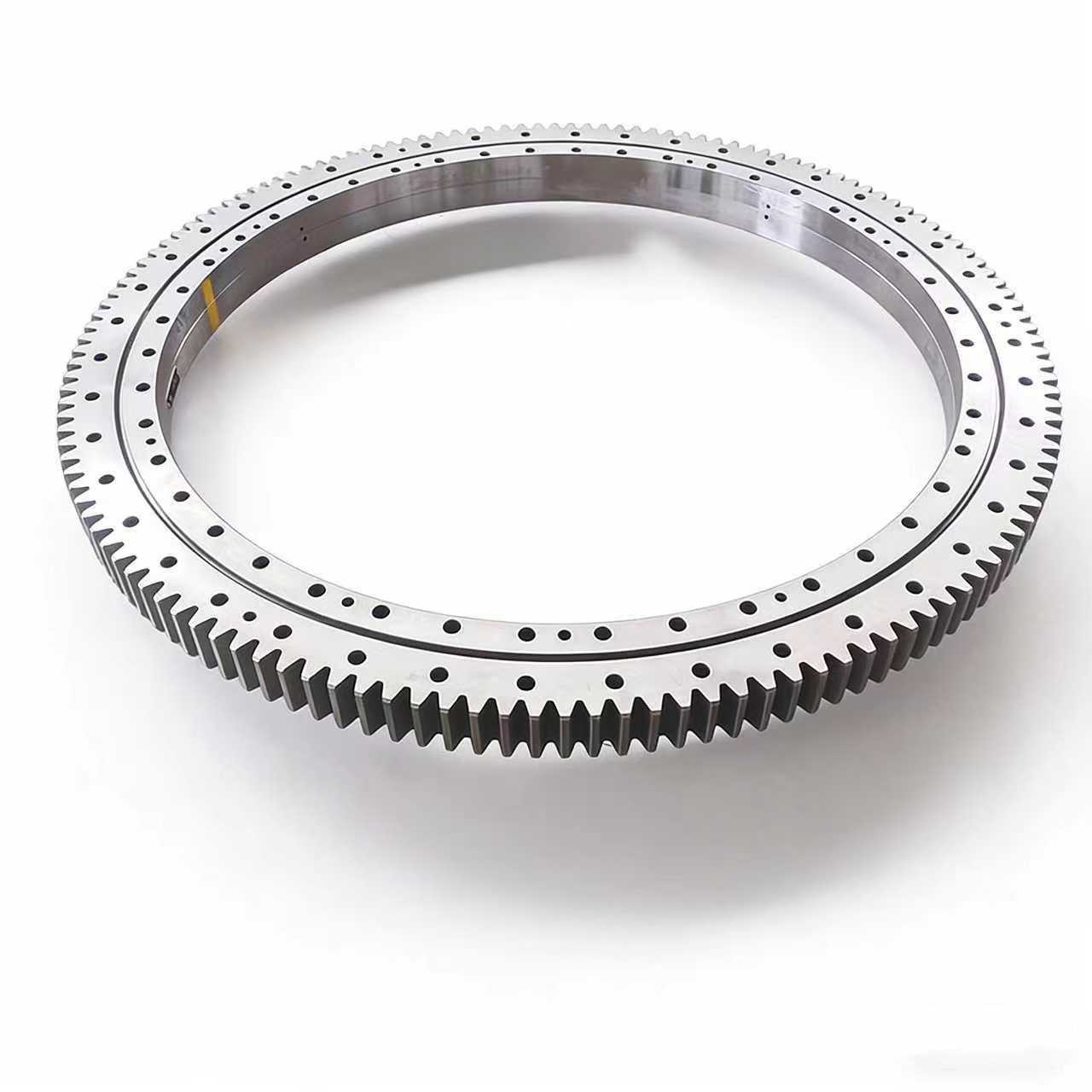
If you’re in the industrial, automotive, or aerospace sector—especially in fields that rely on large-scale equipment like construction machinery, wind turbines, or heavy-duty cranes—you know that axial loads—forces pushing or pulling along the shaft’s axis—are one of the most common (and critical) challenges your equipment faces. Choose the wrong bearing for these loads, and you’re looking at premature wear, costly downtime, and even catastrophic equipment failure. But here’s the good news: as a leading manufacturer of large-scale slewing bearings, we’ve engineered a solution that’s designed specifically to tackle axial loads head-on for heavy-duty applications, while saving you space, time, and money: the 4 point contact ball bearing—a core component of our high-performance slewing bearing lineup.
You might be wondering: Why not stick with the bearings I’m already using? Deep groove ball bearings work for some applications, and paired angular contact bearings can handle axial loads too. But when it comes to balancing performance, space efficiency, and long-term reliability for large-scale, heavy-duty axial load-dominant systems—the kind we specialize in for our slewing bearing products—4 point contact ball bearings stand in a league of their own. As a trusted producer of large slewing bearings, we’ve integrated these high-performance 4 point contact ball bearings into our designs to deliver unmatched durability and efficiency for your most demanding equipment. Let’s break down exactly why they’re the smart choice for your axial load needs—no jargon, just real-world benefits that matter to your bottom line, backed by our expertise in large-scale bearing manufacturing.
1. Unmatched Bidirectional Axial Load Capacity (No Pairing Required)
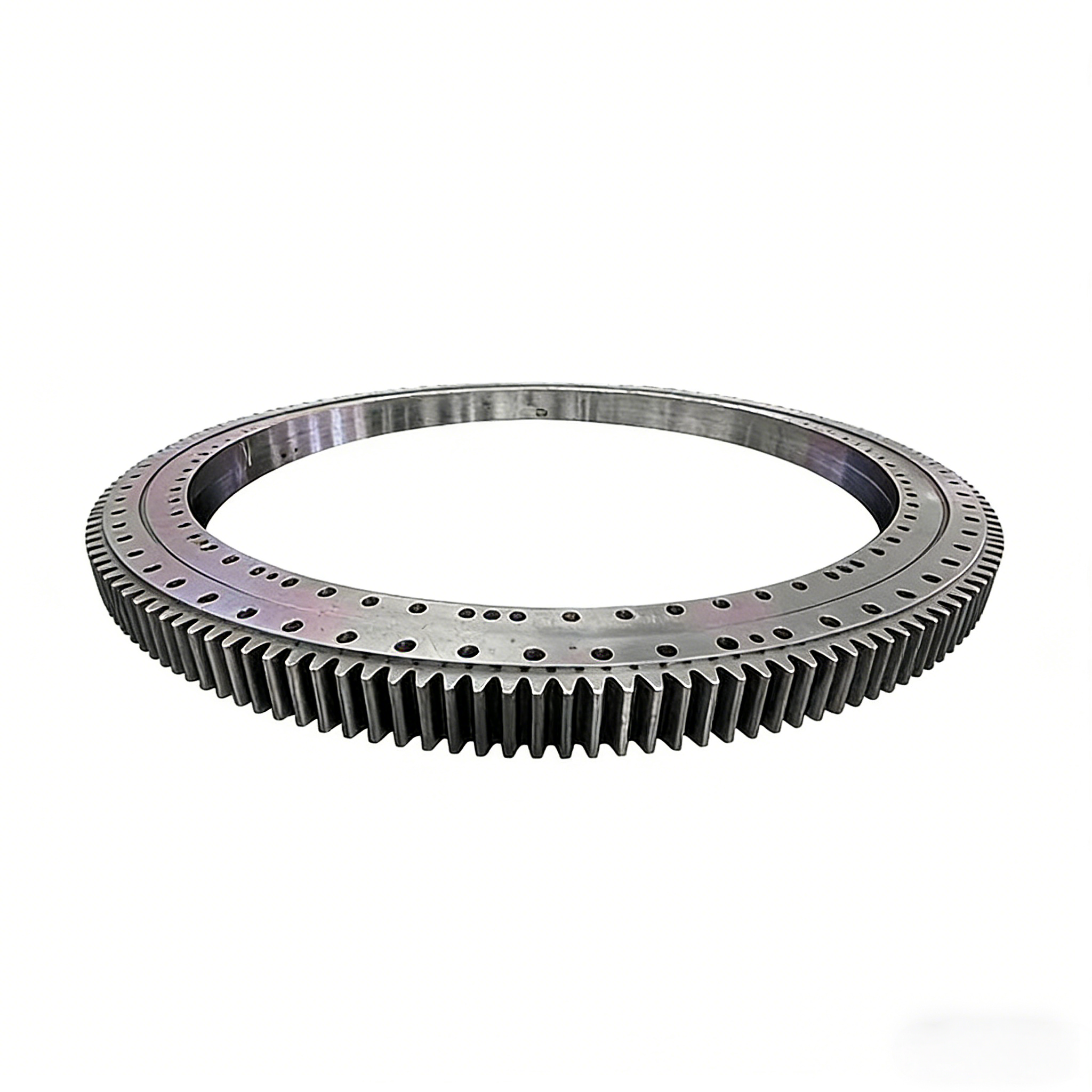
The biggest advantage of a 4 point contact ball bearing is its ability to handle bidirectional axial loads—that’s forces pushing in both directions along the shaft—with a single bearing. Most other bearings? They can only handle axial loads in one direction, which means you’d need to pair two angular contact bearings (back-to-back or face-to-face) to get the same functionality. That’s double the parts, double the installation time, and double the potential for alignment errors.
How does it work? The 4 point contact ball bearing features a unique “gothic arc” raceway design (on the outer ring) and a split inner ring, creating four contact points between the balls and the raceways—two on the inner ring, two on the outer ring . When axial load is applied (in either direction), the balls shift to make two opposing contact points, transferring the load evenly and stably. This design eliminates the need for paired bearings, simplifying your assembly and reducing the risk of misalignment that can shorten bearing life.
For applications like industrial gearboxes, locomotive drives, or compressor shafts—where axial loads shift direction frequently—this is a game-changer. You get the same (or better) load capacity as a paired bearing system, but with half the components
2. Space-Saving Design That Reduces Equipment Footprint
In today’s manufacturing world, space is a premium. Whether you’re designing a compact robotic arm, a high-speed spindle, or a tight-fitting gearbox, every millimeter counts. 4 point contact ball bearings solve this problem by acting as a “two-in-one” solution: one bearing replaces two single-row angular contact bearings.
On average, a 4 point contact ball bearing saves up to 50% of the axial space compared to a paired bearing system. That’s not just a small win—it’s a design flexibility game-changer. You can downsize your equipment, fit more components into the same space, or design sleeker, more efficient machines. For industries like aerospace or robotics, where weight and size are critical, this space savings directly translates to better performance and lower costs.
And don’t worry about sacrificing load capacity for space. The split inner ring design allows for more (and larger) balls, which means the bearing can handle high axial loads without compromising on durability . In fact, the dynamic load capacity of a 4 point contact ball bearing is nearly identical to a paired set of angular contact bearings—with none of the space overhead.
3. High-Speed Performance for Demanding Applications
Axial load applications often require high speeds—think pumps, turbines, or precision machine tools. Many bearings struggle at high RPMs, leading to overheating, increased friction, and premature failure. But 4 point contact ball bearings are engineered for speed, thanks to their optimized design and high-quality components.
Most 4 point contact ball bearings come with outer ring-guided cages (usually made of brass or heat-resistant PEEK), which reduce friction and ensure smooth operation even at high speeds . In fact, their limiting speed is often 70% higher than paired angular contact bearings, thanks to a smaller contact angle (standard 35°) and improved lubrication flow.
For example, SKF’s QJ series 4 point contact ball bearings can reach limiting speeds of up to 14,000 RPM—perfect for high-speed compressors, spindle drives, or locomotive traction motors <superscript:4. This high-speed capability means you can run your equipment faster, boost productivity, and avoid the downtime caused by bearing overheating.
4. Tight Axial Shaft Position Tolerance for Precision
In precision applications—like machine tools, robotics, or optical equipment—axial shaft positioning is non-negotiable. Even the smallest deviation can ruin a product, damage equipment, or reduce efficiency. 4 point contact ball bearings excel here, offering extremely tight axial shaft position tolerance .
The unique raceway design (with independent control over contact angle and axial clearance) ensures that the shaft stays perfectly aligned, even under varying axial loads. Unlike deep groove ball bearings (which have larger axial play), 4 point contact ball bearings have minimal axial, keeping the shaft stable and precise. This is critical for applications where repeatability and accuracy are key—think robotic welding arms, CNC machine spindles, or medical equipment.
5. Cost-Efficiency That Adds Up Over Time
At first glance, a 4 point contact ball bearing might seem like a more expensive option than a standard bearing. But when you factor in the long-term savings, it’s actually the more cost-effective choice. Here’s why:
Fewer components: One bearing replaces two, reducing parts costs and inventory needs.
Reduced installation time: Simplified assembly means less labor cost and faster time-to-market for your equipment.
Longer service life: Optimized materials (improved bearing steel, heat treatment) and design reduce wear and tear, cutting down on replacement costs and downtime <superscript:1.
Lower maintenance: The single-bearing design is easier to lubricate and inspect, reducing maintenance time and costs.
For example, if you’re using paired angular contact bearings in a gearbox, you’ll spend more on parts, more time installing them, and more money replacing them when they wear out. A 4 point contact ball bearing eliminates all those extra costs—while delivering better performance.
When to Choose a 4 Point Contact Ball Bearing (And When Not To)
While 4 point contact ball bearings are ideal for axial loads, they’re not a one-size-fits-all solution. They work best in applications where:
Axial loads are the primary load (SKF recommends a Fa/Fr ratio >1.27) Bidirectional axial loads are presentSpace is limitedHigh speed and precision are requiredThey’re less ideal for applications where radial loads are the primary force (deep groove ball bearings are better here) or where extreme radial loads are present. But for most axial load-dominant systems—from industrial gearboxes to wind turbine yaw systems—they’re the clear choice.
Final Thoughts: Invest in Reliability, Save on Costs
At the end of the day, your equipment’s performance depends on the components you choose. When it comes to axial loads, the 4 point contact ball bearing isn’t just a “good” option—it’s the smart option. It delivers bidirectional load capacity, space savings, high-speed performance, and precision—all while cutting costs and reducing downtime.
Whether you’re designing new equipment or upgrading existing systems, making the switch to 4 point contact ball bearings means investing in long-term reliability. You’ll spend less time dealing with bearing failures, less money on parts and maintenance, and more time focusing on what matters: growing your business.
Ready to see the difference for yourself? Look for 4 point contact ball bearings with high-quality materials (like SKF’s Explorer class) and optimized designs—they’ll deliver the performance and durability you need to keep your equipment running smoothly, even under the most demanding axial load conditions .