Aerial Work Platform Slewing Bearing Failure
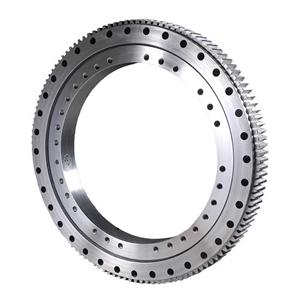
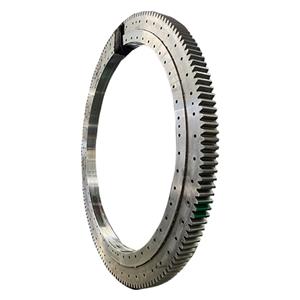
Every boom lift and scissor lift rotates on one component: the slewing bearing. It carries the platform, the load, and the people on it — often with someone working at height. When it fails, the machine goes down, and nobody wants to be in the basket when it happens. The failures we analyze at Luoyang Hengguan Bearing Technology Co., Ltd. are rarely manufacturing defects. They come from predictable — and preventable — conditions. Here is what actually kills an aerial work platform slewing bearing, in the order we see it most often.
1. Bolt loosening and preload loss
This is the quiet killer. The mounting bolts — not the bearing — usually go first. Vibration slowly works them loose, fatigue follows, and by the time the operator notices rocking in the turntable, the joint is already damaged. Watch for rust-colored fretting dust around the bolt circle and "pumping" grease at the joint. Prevention is a torque wrench and a schedule: re-torque new machines after the first 100–200 hours, then at the OEM interval. Never reuse an overtightened bolt.
2. Lubrication breakdown
A slewing bearing lives on grease, and aerial work platforms are rough on it. Grease starvation, the wrong grease, and water washout all end the same way: metal-on-metal contact in the raceways. Pressure washing is a common culprit — water blasting at the seal area flushes the grease out and pushes moisture in. Use the OEM-specified grease (typically EP2 lithium), relube on schedule, and rotate the bearing a few full turns after each regrease. Grease coming out darker than it went in means trouble.
3. Contamination and raceway indentation
Construction sites are the worst environment for a slewing bearing: concrete dust, sand, and mud. When a rolling element runs over a hard particle, it presses an indentation into the raceway — brinelling — and the edges spall under load. Seals are the first line of defense, and they age. Inspect them regularly and replace them at the first sign of hardening or cracking.
4. Overload and shock loading
Rated capacity assumes a centered load under controlled conditions. Real work is different: an off-center basket, a wind gust, or a load swinging at height all concentrate the moment on a small arc of the raceway, which starts to pit. Keep loads centered, respect the capacity chart, and avoid swinging heavy loads at speed.
5. Base structure deformation and misalignment
A slewing bearing is only as rigid as what it sits on. If the mounting surface flexes — a thin base plate or a reworked frame — the load concentrates on one segment of the raceway, and that segment spalls while the rest still looks new. That is why failures often show up in a single quadrant. Check the mounting surface for flatness before installing a new bearing.
6. Corrosion
Moisture gets in, and rust gets started. Coastal sites and aggressive pressure washing feed corrosion at the raceway, and rust pits are stress raisers: once they form, spalling follows. Sealed, properly greased bearings resist this well — but protection is only as good as the maintenance behind it.
7. Reaching the end of calculated life
Even a perfectly maintained bearing wears out. The raceway is induction-hardened to a controlled depth, and contact fatigue eventually outlives it. End-of-life spalling is a maintenance event, not a failure — planned replacement is far cheaper than an unplanned one, especially 400 km from the shop.
Warning signs you should never ignore
Grinding or intermittent noise during rotation
Increasing swing effort or rough rotation
Visible radial play or rocking of the turntable
Grease that is darkened, watery, or contaminated
Loose or corroded bolts around the joint
Prevention: a simple field routine
Lubricate on schedule, and rotate the bearing fully after each regrease.
Torque-check the mounting bolts every 500 hours or per the OEM recommendation.
Keep the seal area clean — never direct a pressure washer at the raceway joint.
Load discipline — centered loads, no overcapacity swings.
Annual inspection — measure backlash and inspect the bolt circle.
The manufacturer's side
At Luoyang Hengguan Bearing Technology Co., Ltd., we build slewing bearings for boom lifts, scissor lifts, and vehicle-mounted platforms from 0.3 m to 3 m outside diameter, with controlled induction hardening depth and sealing and grease specified for the application. When a returned bearing fails, our engineers analyze it and tell you whether it was the bearing or the installation — so the same mistake does not happen twice. For a replacement or custom design, send us your machine model and serial number.